Case Study
QHT Clinic: how a hair transplant clinic called every lead within seconds, day or night
What 75,000+ AI calls taught us about turning ad leads into booked consultations, and how OmniDimension voice AI and workflows made it happen.
Published November 16, 2026

75,000+
AI calls made, with outcomes written back to the CRM
1,200+
Consultations booked by the AI
4,400+
Leads marked interested
Seconds
From a new lead to the first call
At a glance
- Customer
- QHT Clinic, a hair transplant clinic group with clinics in Hyderabad, Delhi and Haridwar
- Industry
- Healthcare, aesthetic and cosmetic surgery
- Lead sources
- Meta lead ads, Google ads, WhatsApp, website popup, online store, inbound phone, creator campaigns
- CRM
- LeadSquared
- Deployed
- Voice AI agents in Hindi, Hinglish and English, plus 8 lead workflows
Overview
QHT Clinic treats hair loss with its own refined FUE method, the QHT Technique. It also sells URoots, an Ayurvedic hair care line, online. Both businesses run on paid ads, and both produce enquiries at every hour of the day.
The clinic did not lack leads. It lacked a way to reach each lead while that person still cared. OmniDimension gave QHT a voice AI front desk that calls every new enquiry within seconds, qualifies it the way a counsellor would, books a consultation, and writes the result back to LeadSquared. Workflows decide who gets called, when, and by which agent.
The challenge
The problem
A person who fills in a hair transplant form at 11 pm is thinking about their hair at 11 pm. By the next morning, they have often filled in two more forms with other clinics. QHT's leads arrived from seven channels, around the clock, and in more than one language. Human counsellors worked clinic hours.
The team faced four questions every day:
- How do we call a lead before a competitor does? Ad leads go cold within minutes, not days.
- What happens to leads that arrive after 6:30 pm? Nearly half of the clinic's leads came in outside office hours.
- Which leads deserve a counsellor's time? A product buyer for URoots and a transplant candidate need different handling.
- How do we keep the CRM honest? If a call result never reaches LeadSquared, the next person to touch the lead starts from zero.
What it cost
- Leads that arrived at night waited until the next working day for a first call.
- Counsellors spent their day dialling numbers that did not answer, instead of talking to people who wanted help.
- Callbacks promised for a set time slipped, because nobody owned the clock.
- Post-transplant patients called with questions and had to wait for a free line.
Key insights from 75,000+ calls
1. Nearly half of all leads arrive when the clinic is closed
2. A lead called in the first minute is ready to book
3. Patients want video first, then the clinic
4. "Call me later" is a promise, and promises need a clock
5. A product lead is not a surgery lead
6. Care after the sale is part of lead management
The solution: key workflows deployed
1. Riya, the AI welcome agent
Riya calls new leads in Hindi or Hinglish and switches to English when the patient does. She works through the same intake a counsellor would:
- age, hair loss history and habits
- medical conditions and current medicines
- the patient's city, which decides the next step
If the patient lives in a clinic city, Riya offers a free in-clinic consultation. If not, she offers a video consultation or travel support. She asks for five scalp photos on WhatsApp so a doctor can assess the case before the visit. She handles common objections on cost and pain, and leaves the final price to the doctor, which keeps quotes accurate.
2. A lead router that knows the source, the hour and the priority
Every new lead enters LeadSquared and triggers an OmniDimension workflow. The workflow reads where the lead came from and what time it is:
- During clinic hours, the lead goes straight to Riya.
- Between 6:30 pm and 10 am, an after-hours agent calls instead. It captures the concern, books a slot where it can, and the team gets a next-morning summary by email.
- URoots product leads go to a separate qualifier agent.
3. URoots lead qualifier
A dedicated agent, Ananya, asks URoots buyers about their hair concern and buying intent, then scores each lead as hot, warm or cold in the CRM. A priority router moves the hottest leads to the top of the team's list. Separate agents handle repeat orders on 3 and 6 month plans.
4. Callbacks that keep their promise
When a lead says "call me tomorrow at 4", the time goes into LeadSquared. A workflow waits for that exact time, puts the lead back in the dialer, and logs the outcome as a CRM activity.
5. Follow-up for leads who never picked up
A stage router reads each lead's disposition. Leads that did not answer get a fresh attempt later, including a re-dial weeks later for leads that went quiet. A WhatsApp "call me now" button lets a lead ask for a call on their own terms.
6. Support after the procedure
An inbound support agent answers post-transplant questions using the clinic's own aftercare guide: washing, swelling, medicines, and what is normal on day 3 versus day 10. If a patient describes a severe symptom, the agent escalates to the clinic team at once. A separate agent re-engages past patients for check-ins, progress photos and reviews.
How it works
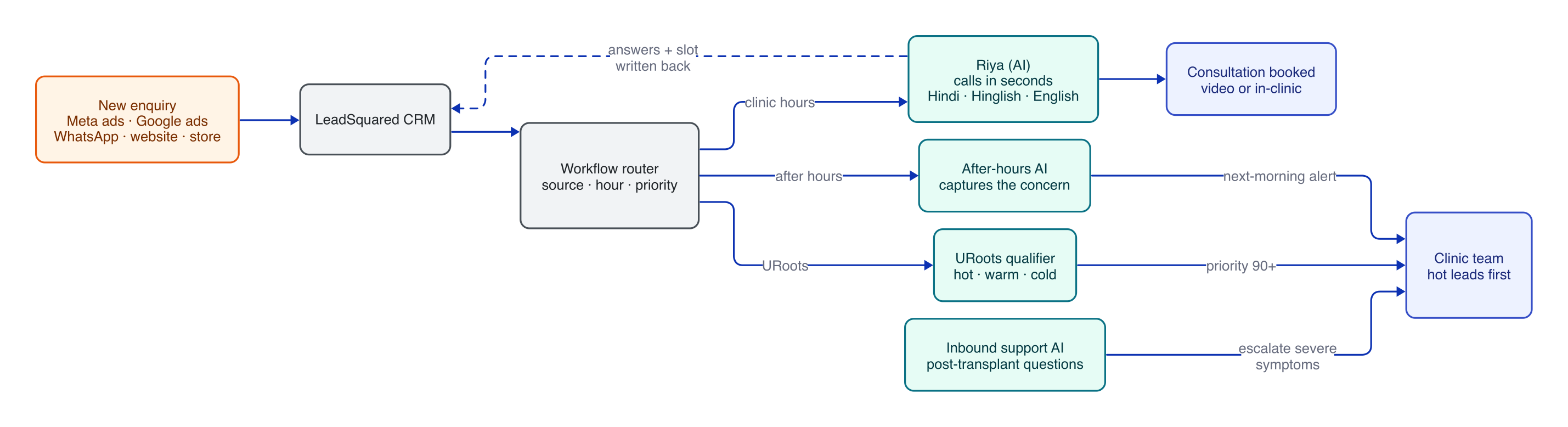
The diagram at the top of this page shows the flow:
- A new enquiry arrives from an ad, WhatsApp, the website or the store.
- LeadSquared records it and triggers the OmniDimension workflow.
- The workflow picks the agent by source, hour and priority.
- The AI agent calls, qualifies, and books where it can.
- Answers and booked slots are written back to LeadSquared.
- Hot leads, after-hours summaries and severe symptoms reach the clinic team first.
Read more on connecting automated phone calls to your CRM and on AI phone call workflows.
The impact
- 75,000+
- AI calls made, with outcomes written back to LeadSquared
- Nearly 19,000
- AI calls in the busiest month
- 1,200+
- Consultations booked by the AI
- 4,400+
- Leads marked interested and handed to counsellors
- 7,000+
- Night leads called within seconds, not the next morning
- 12,000+
- Callbacks made at the time the lead asked for
- About 4 to 1
- Video consultations to clinic visits, reaching patients beyond the three clinic cities
Speed stopped depending on staff hours. Every lead got a call within seconds, at any hour, in the patient's own language.
The clinic's reach went national. Video consultations let QHT book patients far from its three clinics.
The CRM became the source of truth. AI call outcomes flowed back into LeadSquared, so counsellors opened a lead and saw the age, concern, city and booked slot before they spoke.
The outcome
QHT moved its first contact from a human queue to an AI that never sleeps and never forgets a callback. Counsellors stopped dialling cold numbers. They start their day with booked consultations, hot URoots buyers, and a summary of what came in overnight. Patients get a fast, local-language conversation the moment they reach out, and the same care after their procedure.
Lessons for clinics and other lead-driven businesses
- Call in seconds, not hours. A lead's interest decays fast. Speed matters more than a perfect script.
- Staff the night with AI. If half your leads arrive after hours, an office-hours team makes half your market wait.
- Route by source and intent. A product buyer and a surgery candidate should not hear the same call.
- Offer the easy first step. A video consultation books patients who would never travel for a first visit.
- Write everything back. An AI call that leaves no CRM record is a call your team will repeat.
- Let the AI book, and let the doctor quote. Qualify and schedule with AI. Keep medical advice and final pricing with clinicians.
- Keep the patient after the sale. Aftercare calls, check-ins and review requests turn one procedure into referrals.
See how this applies to your clinic: voice AI for hair transplant clinics, AI appointment booking for clinics, and OmniDimension for healthcare.
FAQs
See what OmniDimension can do for your leads
Book a 15-minute walkthrough with our team.